
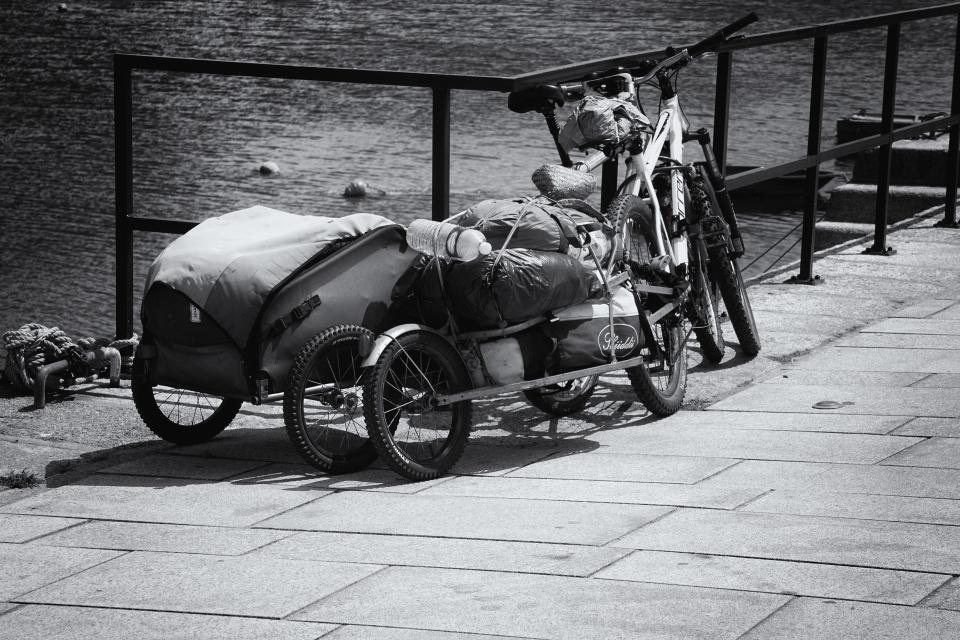
Every loaded bike we have ridden falls into one of two camps, and the choice shapes the whole trip. Either the luggage hangs off racks in panniers, the way touring bikes have carried it for a century, or it straps directly to the frame, saddle and bars in soft bikepacking bags. Both work. Both have quietly ruined a day for us at some point. What follows is our attempt to lay out the trade-offs honestly, with numbers where numbers exist, so you can pick the system that suits the riding you actually do rather than the riding you see in photographs.
What the two systems are
A pannier setup starts with a rack, usually at the rear and sometimes at the front, bolted to eyelets on the frame and fork. Hard-backed bags hook onto the rack rails and hang either side of the wheel. A typical rear pair holds 40 litres between them, a front pair 25 litres, and a rack-top dry bag adds another 10 to 20 litres. Fully built, a four-pannier touring bike can carry 80 to 100 litres of gear.
A bikepacking setup has no racks. A seat pack of 10 to 17 litres wedges behind the saddle, a frame bag of 3 to 8 litres fills the main triangle, and a bar roll of 8 to 15 litres sits across the handlebar. Add a top tube bag, a couple of fork cages and some stem pouches and you reach 35 to 45 litres. That is the real capacity gap: a pannier bike carries roughly twice what a bikepacking bike does, and every decision downstream flows from that.
Weight: the honest arithmetic
The empty hardware tells only part of the story. A rear rack weighs 500 to 700 g in aluminium, and a pair of waterproof panniers 1.5 to 1.9 kg. So before packing a single sock, a rear pannier system adds 2 to 2.6 kg to the bike. A seat pack, frame bag and bar roll together weigh 800 g to 1.2 kg, so the bikepacking rider starts about 1.5 kg ahead.
That advantage is real but modest, and it is dwarfed by what happens next. With 90 litres available, most of us fill 70 of them. With 40 litres, we fill 40 and stop. In our experience the finished pannier bike leaves the house 6 to 10 kg heavier than the finished bikepacking bike, and only a kilo and a half of that is hardware. The bags do not make you light; the constraint does.
The flip side is that the constraint is not optional. On a two-week ride with a tent, stove, cold-weather layers and four days of food, 40 litres is genuinely tight, and the bikepacking rider ends up buying lighter gear or strapping things to the outside where they rattle and snag.
Handling: where the weight sits
This is the difference we feel most on the road. Panniers put mass low and wide, beside the axle. On tarmac and smooth gravel that gives a stable, planted feel, and the bike tracks straight with a full load. But the same width catches every rock on singletrack, the rear end wags on rough descents, and the low centre of gravity turns into a pendulum once the front wheel starts skipping. Front panniers make steering heavy and slow at speed, and the classic shimmy on a fast descent usually starts with a loaded front rack.
Bikepacking bags keep everything inside the silhouette of the bike. The frame bag sits at the lowest, most central point possible, which is the best place on the machine for dense items such as tools, food and water. The seat pack rides high and rearward, which is the worst place, so it needs the lightest, bulkiest gear: sleeping bag and clothing. Set up that way, a soft-bag bike handles almost like an unloaded one on technical trail. Set up badly, with the seat pack full of tins, it sways side to side with every pedal stroke and the wagging can be felt through the saddle by mid-morning.
The bar roll deserves its own warning. Anything over 3 kg across the bars makes a drop-bar bike feel vague, and it interferes with cables, lights and brake levers. Keep it to a tent body and poles, or a sleeping mat, and the front stays sharp.
Cost: hardware, and what it forces you to buy
A basic rear rack and a decent pair of roll-top panniers cost in the region of 150 to 300 euros and last a decade with occasional hook replacement. That is hard to beat. A full bikepacking kit of seat pack, frame bag and bar roll runs 250 to 450 euros for reputable stitched gear, and custom-fitted frame bags push higher still. On hardware alone, panniers win.
The hidden cost cuts the other way. Bikepacking bags demand compact, lightweight camping gear, and a small tent, short mat and compressible bag can run to 600 euros or more if you are starting from bulky car-camping equipment. Panniers let you tour with whatever you already own. Conversely, panniers require a frame with eyelets, and many gravel and mountain bikes lack them, which pushes riders toward clamp-on racks that add weight and can fail on rough ground.
Our rule of thumb by trip type
- Paved and smooth-gravel tours of any length, especially with cooking and cold-weather kit: rear panniers, possibly a bar roll for the tent.
- Mixed gravel and singletrack up to a week, in mild weather: full bikepacking bags, nothing on the outside.
- Rough routes of two weeks or more with long resupply gaps: bikepacking bags plus fork cages, and accept that the bike will be heavier than you would like.
- Any trip with a hike-a-bike section: soft bags only. Panniers on a shoulder-carried bike are a special kind of misery.
- A first tour, on a bike you already own: whichever system fits the frame. The bags matter far less than the miles.
Hybrids and the case for mixing
The two systems are not exclusive, and some of our best-handling setups have been mongrels. A single small rear rack with mini panniers of 10 to 12 litres each keeps the width narrow enough for most trails while restoring the easy access that seat packs lack. A frame bag pairs beautifully with rear panniers, taking the heavy tools and food out of the bags and into the triangle. And a bar roll on a pannier bike carries the tent without loading the front rack at all.
What we would avoid is the reverse: full-size rear panniers combined with a large seat pack. It piles everything at the back, lifts the front wheel on steep climbs, and the seat pack tends to rub on the rack top. If the load will not fit in one system, the answer is to remove something, not to add a bag.
Whichever way you go, load the bike fully at home, ride it round the block, and stop after the first hour on the road to tighten every strap. Bags settle, racks loosen, and that first adjustment, more than the choice of system, is what makes a loaded bike feel right.