
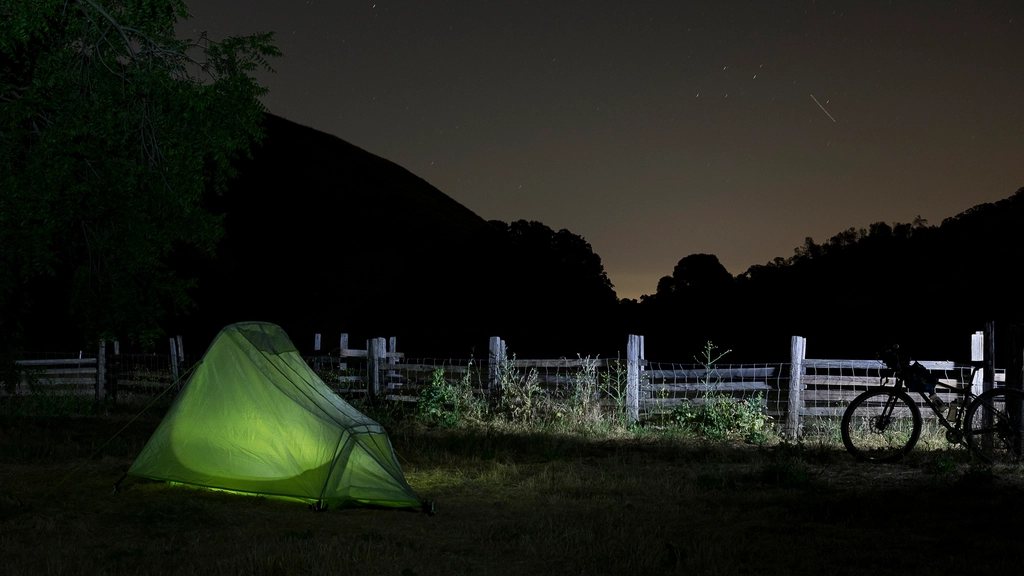
Every bikepacking route long enough to need a tent will eventually cross a line where the rules change. On one side of the border a night on the hillside is a right written into law; on the other it is tolerated, ignored, or fined. We have spent enough nights guessing to know that the guessing is the tiring part. This is our attempt to lay out, in general terms, what applies where, so that the evening decision is about the view and the wind rather than a nervous read of the map. Laws change and local bylaws sit on top of national ones, so treat what follows as a starting point and check the current wording before a trip.
Two different ideas: wild camping and stealth camping
It helps to separate the two things people mean. Wild camping is pitching a tent away from a campsite in a place where doing so is legal or openly tolerated. Stealth camping is pitching where you would rather not be seen: late in, early out, no fire, no trace. The first is a right to be exercised with care; the second is a judgement call that depends on the country, the landowner and your own manners. Most of what follows concerns the first. Where a country gives no right at all, we describe how bivouacking is usually treated in practice, which is not the same as saying it is allowed.
The Nordic countries: a right, with conditions
Norway, Sweden and Finland share a tradition of free access to the land, known in Norway as allemannsretten. In Norway you may camp on uncultivated land for up to two nights without asking, as long as the tent stands at least 150 m from the nearest inhabited house or cabin. Longer stays or a pitch closer than that require the landowner’s agreement. Cultivated land, meaning fields, meadows and young plantations, is off limits in the growing season. Sweden works on the same principle for a night or two, with the same courtesy of distance from houses, and Finland follows suit, though its national parks and nature reserves usually direct campers to marked sites. Iceland is the exception in the north: since a change in the nature conservation law, camping outside designated sites is limited to a single night with a conventional tent in uninhabited areas along a route, and it is forbidden near cultivated land without the owner’s permission and inside most national parks. Most riders we meet in Iceland simply plan around the campsite network, which is dense enough on the ring road and thinner inland.
The British Isles: Scotland yes, the rest mostly no
Scotland is the clearest case in Europe. The outdoor access code that followed the 2003 land reform legislation gives a right of responsible access that includes wild camping, on foot or by bike, on most unenclosed land. The word responsible is doing real work: small groups, short stays, no fires in dry spells, and a pitch well away from houses and roads. One important exception is the eastern shore of Loch Lomond and parts of the surrounding national park, where seasonal bylaws run from March to the end of September and require a permit or a pitch on a designated site. England and Wales offer no general right. Landowner permission is the legal position, and high, remote pitches in the hills are tolerated by custom rather than by law. Dartmoor is the one part of England where a right to backpack camp on the open commons has been tested in court and confirmed. Ireland is similar to England: no right, and a quiet word with a farmer goes a long way.
The Alps and the Mediterranean: bivouac, not camping
France draws a line that is useful to understand because Italy and Spain often behave the same way in practice. Camping, meaning a tent that stays up in daylight, is banned in many places: beaches, protected coastlines, the core zones of national parks, near water supplies and historic monuments. Bivouacking, meaning a tent pitched around sunset and packed at dawn, is tolerated in the mountains and formally permitted in several national parks under conditions. The Ecrins, for example, allows a bivouac between 7 pm and 9 am provided you are more than an hour’s walk from the park boundary or the nearest road access. Switzerland generally accepts a night above the treeline outside reserves and wildlife protection zones, but cantons and communes add their own restrictions. Austria and Germany are stricter. Several Austrian states ban tents in open country outright, and German forests are closed to camping by federal forest law, with a handful of designated trekking pitches that need booking in advance. Italy regulates by region; high bivouacs are broadly tolerated, valley floors are not. Spain also legislates by region, and the honest summary is that a tent on a beach or beside a road will attract attention while a tent at 2,000 m after dark rarely does. Portugal tightened its rules in 2021 and now expects tents and vehicles to use designated areas.
North America, Oceania and beyond
The United States is generous on the right land. National forest and land managed by the federal land bureau allow dispersed camping, usually for up to 14 days in one spot, and this covers most of the Great Divide corridor. National parks are the opposite: a backcountry permit and an assigned site are the norm, and the permit systems fill early in summer. Canada’s provincial crown land permits free camping for residents for a limited stay, commonly 21 days, and non-residents may need a permit in some provinces. New Zealand allows freedom camping on public conservation land unless a sign says otherwise, but local councils restrict it heavily near towns and coastlines. Australia varies by state and is stricter than its size suggests. Japan has no national law against a tent in the hills, and quiet bivouacs are widely tolerated outside national parks and away from towns. In the Balkans, the Caucasus and much of Central Asia, wild camping is a normal part of rural life; asking is a courtesy that usually ends with an invitation to dinner.
The habits that work everywhere
Whatever the legal position, the same behaviour keeps the welcome open for the next rider. We arrive late and leave early. We pitch out of sight of houses, roads and the trail itself, on ground that will not show a tent print the next morning. We never light a fire in a country or a season where it is not clearly permitted, and in practice we rarely light one at all. We carry out everything, including food scraps and toilet paper, and we dig a proper hole at least 50 m from water. We keep the group small, one or two tents, and we do not stay a second night in the same place unless the rules explicitly allow it. And if someone asks us to move, we move without arguing. A bike makes that easy: it takes 10 minutes to pack, and the next flat patch is rarely more than a few kilometres away.