
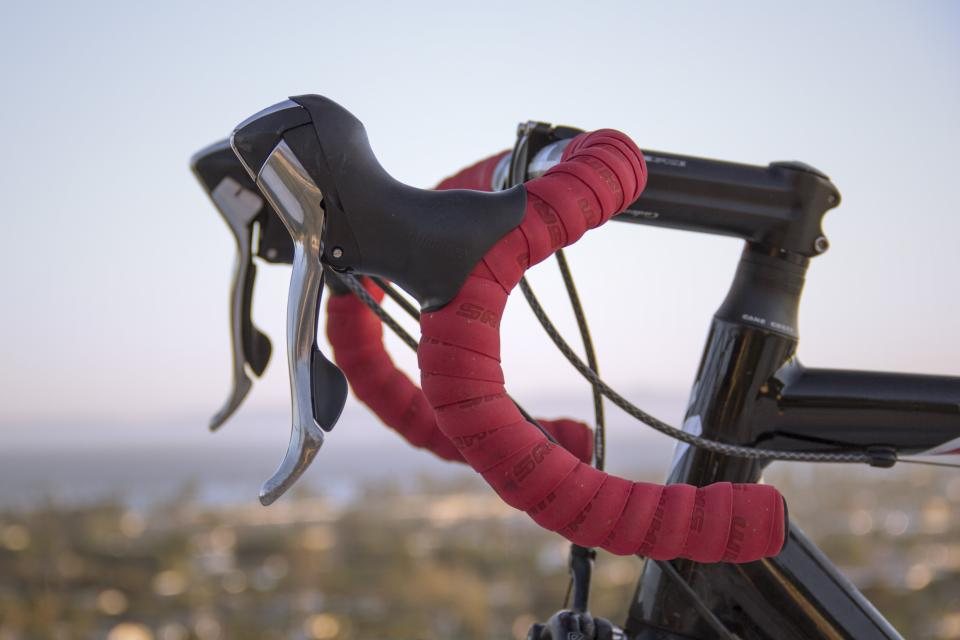
A loaded bike touches the rider in three places, and after eight hours each of them has an opinion. Saddle sores, numb fingers and a stiff neck end more tours than mechanical failures do, yet most of us spend far longer choosing bags than adjusting the saddle. What follows is what we have learned about setting up the three contact points for long days in the saddle, where the aim is not speed but the ability to get up the next morning and do it again.
Why touring position is different
A racing position puts the rider low and forward, with a good deal of body weight carried through the arms and a saddle tilted for pedalling at high power. That works for four hours at threshold. Over eight to ten hours at a conversational pace, with the bike heavier and the surface rougher, the same position loads the hands, compresses the neck and pushes the sit bones forward onto soft tissue. The touring answer is to bring the bars up and back, sit more upright, and let the saddle carry the weight the arms no longer do. The rule of thumb we use is bars level with the saddle or up to 3 cm above it, and a reach short enough that the elbows stay bent on the hoods.
Load changes the picture again. A bar roll and front bags stiffen the front end and reduce the vibration that reaches the hands, while a rear-heavy setup lightens the front and makes the steering nervous on rough ground, which means more gripping and more fatigue. Position and packing should be adjusted together.
The saddle: width, tilt and height
Saddle problems are nearly always width or tilt, not padding. The sit bones should rest on the widest part of the saddle, and the width between them, which ranges from about 100 to 150 mm across adults, sets the saddle width. A saddle too narrow puts weight on soft tissue; too wide rubs the thighs. Measuring is easy: sit on a piece of corrugated cardboard on a hard chair, lean forward slightly, and measure the centres of the two dents. Add 20 to 25 mm for a moderately upright touring position.
Tilt should be level or a degree nose-down, never more. A nose-up saddle presses forward; a nose-down saddle slides the rider onto the hands. Height is right when the knee is bent about 25 to 35 degrees at the bottom of the stroke with the heel slightly above the pedal. On a loaded bike we drop the saddle 3 to 5 mm from the unloaded setting, because the more upright position and the slower cadence favour a slightly lower position, and because putting a foot down on loose ground with a 20 kg load is easier.
Break in matters. A new saddle, especially a leather one, needs 500 to 1,000 km before a long tour. Carry chamois cream and use it before soreness starts rather than after, and wash and dry shorts every evening. Saddle sores are a hygiene problem before they are a fit problem.
Bars: shape, width and height
For gravel and touring, the bars are as much about hand positions as steering. Drop bars with a shallow drop of 100 to 125 mm and a flare of 12 to 20 degrees give four usable positions: the tops, the hoods, the drops and the ramps behind the hoods. Flat bars offer one main position unless bar ends are added, which we recommend for anything longer than a weekend. Alternative bars with swept-back or loop shapes add positions at the cost of some directness on descents, and suit riders who prefer an upright posture.
Width should roughly match the shoulders for drop bars, with a slightly wider bar giving more leverage on a loaded front end. For flat bars, 700 to 760 mm suits most riders for control, though narrower bars slip through trees more easily on overgrown tracks. Bar height, as above, wants to be near saddle height. A stem 10 to 20 mm shorter than the racing standard, with a positive rise, is usually all it takes to get there without a new frame.
Hands: the numbness problem
Numb fingers on a long day come from pressure on the ulnar nerve at the heel of the hand or the median nerve at the wrist. The fixes are mechanical: spread the load across more positions, reduce the weight on the hands, and cushion the vibration. Thick bar tape with a gel underlay, or a double wrap, cuts the buzz on gravel. Padded gloves help, though thick padding can itself press on the nerve. Changing hand position every ten minutes is the single most effective habit, which is why the extra positions on drop bars matter so much.
The deeper fix is upstream. If the hands are sore, the saddle is usually too high or too far forward, tipping weight onto the front. Try moving the saddle back 5 mm and down 3 mm before touching the bars. Wider tyres at lower pressure, as covered elsewhere, remove more vibration than any tape can absorb. And a bar roll of 2 to 3 kg damps the front end noticeably; an unloaded fork on a rear-heavy bike chatters.
Small changes we make on the road
- Day one afternoon: check saddle height with a marker line on the seatpost. Bags loosen clamps.
- Any tingling in the outer two fingers: move the hands to the tops, shake them out, and lower the saddle 2 mm at the next stop.
- Sore neck: raise the bars by moving a 5 mm spacer above the stem to below it. Carry the multitool that fits.
- Hot spots on the sit bones: saddle nose down one degree, or move the cleats back 2 mm to shift the body rearward.
- Re-wrap bar tape at any rest day where the outer layer has worn through; a bare bar is a numb hand by lunchtime.
Feet and the fourth contact point
Strictly there are three contact points, but the feet deserve a word because they connect to the other two. Cleats set too far forward load the calves and push the rider forward on the saddle; moving them back 5 to 10 mm, close to the middle of the foot, relaxes the whole chain and suits long days at low power. Shoes should have a stiff sole but enough room to walk and to push the bike, and on a hot day at kilometre 150 the feet swell a half size, so a roomy toe box is a comfort not a luxury. Flat pedals with grippy shoes work well for hike-a-bike routes and remove the cleat question entirely.
The common thread is patience. Each of these adjustments is a few millimetres, and the body takes a day or two to report back. Change one thing at a time, ride, and listen. A bike that fits for eight hours is built from a dozen small decisions, none of them dramatic, all of them noticed by the end of a week.