
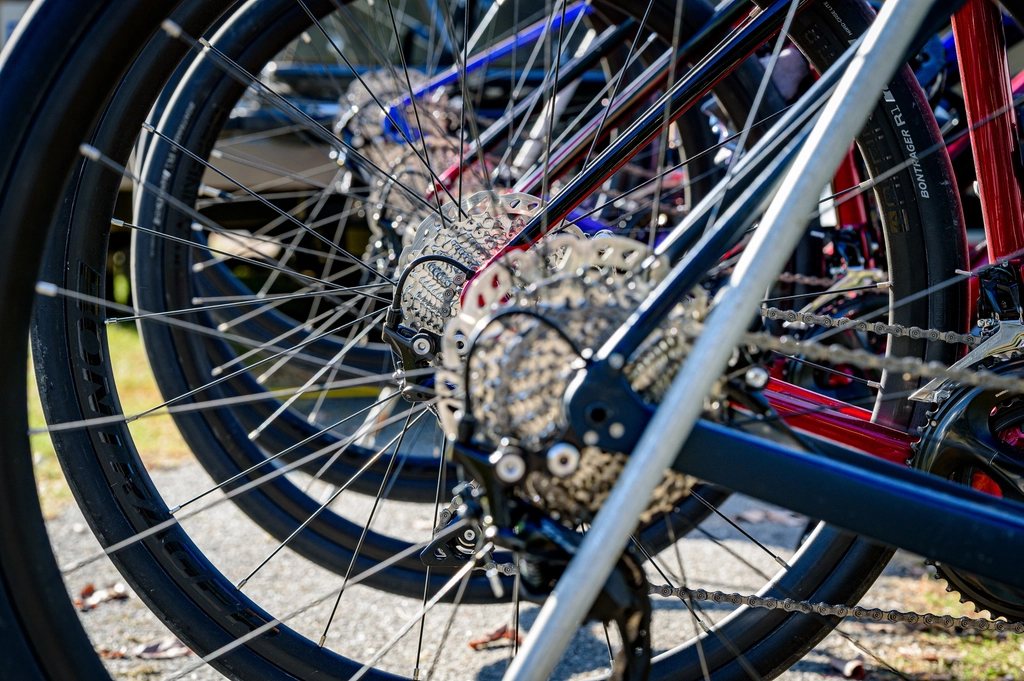
Nothing on a loaded bike changes how it feels as cheaply and as quickly as the tyres. We have watched the same bike, on the same track, go from harsh and skittish to calm and grippy with nothing more than a wider tyre and a few strokes less air. Yet tyre choice is the area where we still see the most habit-driven decisions: riders inflate to the number printed on the sidewall because it is printed there, or run 35 mm rubber on a 30 kg bike because that is what came with it. This is our working method for getting width and pressure right when the bike is carrying luggage and the road has stopped being a road.
Why width matters more than tread
The contact patch of a tyre is roughly the load on it divided by the pressure inside it. Double the pressure and the patch halves; carry twice the weight and it doubles. A wider tyre at the same pressure does not so much grow the patch as change its shape, making it shorter and wider, which reduces the amount the casing flexes each revolution. Less casing flex means less energy lost to hysteresis, which is why, at equal pressure on a rough surface, the wider tyre is not slower. The old belief that narrow tyres are fast came from smooth velodromes, not gravel tracks.
For loaded riding there is a second reason. A wider tyre can be run at lower pressure without the rim striking the ground, and lower pressure is what turns washboard and embedded stones from impacts into undulations. On a long day that is the difference between numb hands at kilometre 60 and a body that still works at kilometre 120.
Picking a width for the job
Our starting points, assuming the frame has clearance, are simple. For fast unpaved roads, tarmac links and a light load under 8 kg, 38 to 42 mm suits most riders. For mixed gravel with loose climbs, rocky sections and a full bikepacking load of 10 to 15 kg, 45 to 50 mm is where the bike starts to feel composed. For long rough-country routes, sand, or a touring load above 20 kg, 2.1 to 2.4 inches on a 29 inch wheel, which is 53 to 61 mm, is what we would fit without hesitation. On a 27.5 inch wheel, 2.4 to 2.6 inches covers the same ground with a slightly smaller rolling diameter.
The constraint is nearly always the frame. Measure the gap at the chainstays and the fork crown with the current tyre inflated, and leave at least 6 mm each side for mud and for wheel flex under load. A tyre that just fits on a dry day will stop the bike dead on the first clay descent after rain.
Tread, by contrast, is a secondary decision. A low file-tread centre with modest side knobs covers nine gravel days out of ten. Only in real mud or on steep loose descents do aggressive knobs earn their extra weight and noise, and even then we would rather have the extra width than the extra tread.
Casing, tubeless and the puncture question
Two tyres of the same width can ride completely differently depending on the casing. Supple, high thread-count casings are faster and more comfortable but cut more easily on sharp rock. Stiffer casings with puncture belts add 100 to 200 g per tyre and a noticeably dead feel, but they survive flint and thorns. For a week on forest roads we take the supple option; for a month across dry rocky country we take the armour and accept the loss.
Tubeless is, for us, the default on anything over 40 mm. Sealant closes the small holes that would have been a roadside inner-tube change, and the absence of a tube removes the pinch flat that limits how low a tubed tyre can safely go. The cost is maintenance: sealant dries out in three to six months in warm climates and needs topping up before a trip, and the bead must be seated properly, which can be hard with a small pump far from home. We carry a tube anyway, always, and a plug kit for cuts too large for sealant.
Pressure: the number you actually need
Forget the sidewall maximum. It is a safety limit for the bead, not a recommendation. Instead, think in terms of total system weight, which is rider, bike and luggage together, and the width of the tyre. As a rough field guide for a 45 mm tubeless gravel tyre, we start at 2.4 bar rear and 2.2 bar front for a system weight of 85 kg, and add roughly 0.1 bar for every 5 kg above that. For a 2.2 inch tyre the same rider would start near 1.8 bar rear and 1.6 bar front. For a 38 mm tyre, 3.2 rear and 3.0 front.
Then we adjust by feel. The test is a hard corner on loose gravel and a run over washboard. If the bike skips sideways on the corner or chatters on the washboard, let out 0.1 bar and try again. If the rim clunks on a rock, the tyre folds in a corner or the bike feels sluggish on smooth tarmac, add 0.1 bar. The right pressure for a loaded bike is nearly always lower than the rider expects, and often 20 to 30 percent below what feels normal on an unloaded bike.
Front and rear should differ. On a loaded bike with a seat pack and rear panniers, 60 percent or more of the weight sits on the rear wheel, so it needs the extra air. With a bar roll and front panniers the split evens out and so should the pressures.
Adjusting on the road
- Before a long paved transfer, add 0.3 to 0.5 bar. Roll faster, then bleed it off at the first gravel.
- Before a long rocky descent, drop 0.2 bar for grip and comfort, but check the rim does not bottom out on the first big hit.
- After a resupply that adds 5 kg of food and water, add 0.1 bar at the rear.
- In cold mornings pressure reads lower; in hot afternoons on black tarmac it climbs. Set pressures once the tyre is at ambient temperature.
- Carry a small gauge. Thumb tests are wildly unreliable below 3 bar.
The mistakes we see most
The first is buying the widest tyre that fits, then inflating it as if it were a 32 mm tyre, which gives the weight of the big tyre with none of its comfort. The second is running identical pressures front and rear regardless of where the bags are. The third is fitting tubeless and forgetting the sealant until day three. And the fourth, most common of all, is never experimenting. Ten minutes with a gauge on a familiar loop, dropping a tenth of a bar at a time, teaches more than any chart, including this one. The bike will tell you when it is right; it stops fighting the ground and starts flowing over it.