
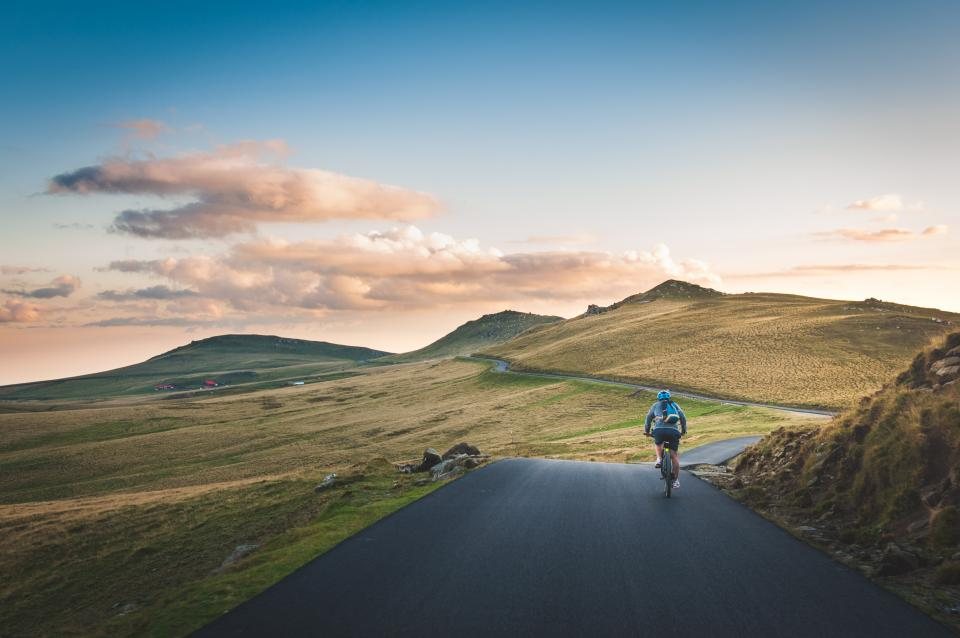
The Carretera Austral is Chile’s Route 7, a road pushed through the fjords, rainforest and ice fields of northern Patagonia from Puerto Montt to Villa O’Higgins. On paper it is about 1,240 km. On a bike it is a month of ferries, gravel, rain, turquoise lakes and a wind that comes from the west with nothing to slow it down. It is one of the great road-based bikepacking trips of the world precisely because the road itself is so unfinished: it exists as a single line, it ends at a lake, and a fair share of it is still loose ripio.
A road that is still being built
Construction began in the mid 1970s to connect isolated settlements that were previously reachable only by sea or through Argentina. The road reached Villa O’Higgins in 2000, and paving has been advancing ever since. Today the northern section from Puerto Montt to Hornopiren is paved, much of the stretch from Chaiten to Coyhaique is paved, and the road south of Cerro Castillo is mostly gravel with new sections of asphalt appearing every year. “Ripio” is the local word for that gravel: sometimes hard-packed and fast, sometimes loose, corrugated and deep enough to stop a loaded bike dead. The southern half is where the ripio lives, and it is also where the scenery is at its most extreme.
The ferries in the north
There is no continuous road in the north, and that is part of the charm. Between Puerto Montt and Chaiten the route uses three ferry crossings. The first, at La Arena, is short and frequent. The second and third, from Hornopiren to Caleta Gonzalo, run as a combined service with a drive between the two boats and take most of a day; in summer they run daily, but they book out, and in winter they are far less frequent. Bikes generally go on as foot passenger luggage, which is cheap and simple. South of Caleta Gonzalo the road enters a park of temperate rainforest with enormous alerce trees and free or low-cost camping, and then reaches Chaiten, a town rebuilt after the volcano above it erupted in 2008.
There is a fourth ferry far to the south, between Puerto Yungay and Rio Bravo, which is free, short and essential: without it there is no road to Villa O’Higgins at all.
The middle: hanging glacier, Cerro Castillo and the big lake
From Chaiten the road climbs inland past Lago Yelcho, then over a pass to La Junta and Puyuhuapi, a fjord village founded by German settlers. Just south of Puyuhuapi is one of the most photographed spots on the road, a glacier hanging above a cliff with waterfalls pouring from its snout, reachable by a short trail from the road. After a steep gravel pass through cloud forest the road drops to Coyhaique, the only real city on the route with around 60,000 people, a proper supermarket and bike shops. Most riders take a rest day here.
South of Coyhaique the road climbs to a pass under Cerro Castillo, a fortress of spires that is worth a day on foot, then descends to the shore of Lago General Carrera, the second largest lake in South America. The road hugs its western side for over 100 km of relentless climbs and descents on gravel, with the water an unlikely milky blue below. Near Puerto Rio Tranquilo, boats run to the marble caves on the shore, a short and worthwhile detour.
The south: Cochrane, Tortel and the end of the road
Beyond the lake the road follows the Rio Baker, one of the biggest rivers in Chile, to Cochrane, the last town with a decent range of supplies. Then it gets quiet. The side road to Caleta Tortel leads to a village built entirely on cypress boardwalks with no streets at all, and it is worth the extra 40 km round trip. After the Yungay ferry the final 100 km to Villa O’Higgins is a lonely, hilly, beautiful ribbon of gravel along glacial rivers, and the village at the end is a dead end for cars.
It is not a dead end for bikes. In summer a boat crosses Lago O’Higgins to a Chilean border post, and from there a track climbs and then drops about 22 km through forest to Lago del Desierto on the Argentine side. Sections of that trail are unrideable with a loaded bike: expect pushing, carrying, mud and fallen trees for several hours. On the far side, a second boat or a walking trail leads to a gravel road that ends in El Chalten, under the granite towers of the Fitz Roy range. Finishing the Carretera this way, with a border crossing on foot, is the right ending.
Wind, weather and season
The riding season runs from November to March. December to February brings the longest days and the most reliable ferries, but also the strongest wind and the most traffic. The wind is a westerly and in the south it is a daily fact, often 40 to 60 km/h in the afternoons, occasionally strong enough to push a bike off the road. The direction of travel matters: most of us ride north to south so that the wind is more often on the side or behind, and starting early each day gets the calm hours. Rain is heavy in the north, where some places see over 3,000 mm a year, and lighter in the south around Cochrane. Expect every kind of weather in a single week, and pack a tent that can be pitched fast.
Planning notes
- Distance and time: 1,240 km plus detours, typically 3 to 5 weeks at 50 to 70 km per day with rest days.
- Bike: tyres of 45 mm or wider; a low bottom gear; sturdy racks if you use panniers, as the corrugations are hard on hardware.
- Food: shops are small and irregular south of Coyhaique; carry three to four days of food from Cochrane onward.
- Money: cash is essential in the small villages; card payment is unreliable and there are few cash machines between Coyhaique and the end.
- Camping: formal campsites are common and cheap, wild camping is tolerated in many places outside towns and parks, and rural hospitality is genuine.
- Getting there and back: buses and flights serve Puerto Montt and Coyhaique; from El Chalten, buses run to El Calafate and its airport.
The Carretera Austral is not hard in any single kilometre. It is hard in the accumulation of gravel, rain, wind and distance, and that is precisely why the day you roll into Villa O’Higgins, or the afternoon you push your bike over the border into Argentina, feels like something earned.