
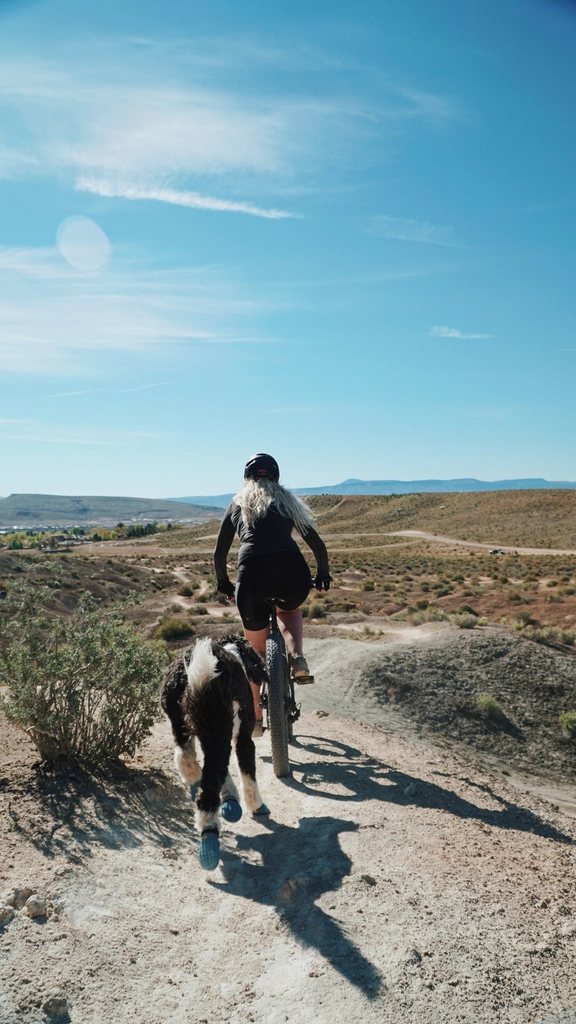
Every mixed trip has a moment where the riding stops and the bike becomes luggage. Sometimes it lasts twenty metres over a fallen tree, sometimes it lasts three hours up a scree gully. How we handle that moment decides whether the day ends with a grin or with a strained shoulder and a bent derailleur. After enough kilometres of pushing loaded bikes through the wrong terrain, we have settled on a simple decision tree: push, carry or leave. Each option has a threshold, and the threshold moves with the load on the bike, the weather and the hours left in the day.
The honest arithmetic of walking speed
Start with numbers, because they cut through optimism. On a good trail with a loaded bike, pushing uphill averages 2 to 3 km/h. Carrying on the shoulder over rough ground drops that to around 1 km/h, and on steep, loose slopes we have measured 300 vertical metres per hour at best. Compare that with a fit walker without a bike, who manages 400 to 500 vertical metres per hour on the same slope. The bike costs us roughly a third of our climbing rate, more when it weighs over 20 kg with bags.
That is why we plan hike-a-bike sections in vertical metres and hours, not in horizontal kilometres. A 4 km ridge traverse that looks trivial on the map can eat an entire afternoon if it gains 600 m over boulders. Before committing, we ask a blunt question: does the riding on the far side justify the walk? If the descent beyond the pass is a rideable track for 15 km, yes. If it is another walk, the answer is usually to find a different line.
Pushing: the default that most people do badly
Pushing is the least tiring mode as long as the ground is walkable and the gradient stays below about 25 percent. The technique that saves energy is simple but rarely taught. Stand on the uphill side of the bike, one hand on the bar near the stem and the other on the saddle or seatpost, and let the bike roll beside you rather than in front. Pulling on the bar from behind, which is what tired people do, forces the front wheel to climb every rock and throws the bike back into your shins.
Handlebar bags and fork-mounted cages change the balance. A heavy front end wants to twist downhill on every off-camber step, so we shift dense items such as water and food to the frame bag before a long push. On very steep sections we use the rear brake as a ratchet: two steps, squeeze, breathe, release, two more steps.
Carrying: where the bags come off
The switch from pushing to carrying happens when the front wheel cannot roll: staircase rock, deep bog, dense scrub, or slopes above 30 percent where every push slides back. Carrying a fully loaded bike is a sport in itself, so the first move is almost always to strip it. A 12 kg bike with 8 kg of luggage becomes two loads: the bike on the shoulder and the gear in a small pack we carry precisely for this purpose.
The classic cyclocross shoulder carry, with the top tube on the shoulder and a hand through to the bar, works for short bursts. For anything over a few hundred metres we prefer a strap: a simple length of webbing from the head tube to the seat tube turns the bike into a rough shoulder bag and frees a hand for the ground.
- Under 25 percent and a rolling front wheel: push, uphill side, brake as a ratchet.
- Rocky steps, bog, dense vegetation or over 30 percent: strip the bags and carry.
- Exposed scrambling with hands needed: lash the bike to the pack or stop.
- More than three hours of carrying forecast: reconsider the route before you start.
Leaving the bike: the option nobody plans for
There is a third choice that mixed-mode travellers use far more often than pure bikepackers admit. Lock the bike to a tree or a signpost at the last rideable point, walk the summit or the col on foot with a light pack, and return by the same line. A there-and-back of 8 km and 900 m of ascent takes three to four hours on foot. With the bike it might take six, and the descent on the far side is rarely worth the difference.
Leaving the bike works best when the walking section is a dead end, a peak or a viewpoint rather than a through-route. We stash it out of sight of the trail, take the bags that contain valuables and water, and photograph the spot with the coordinates displayed on the screen. The one rule is to leave nothing edible on it, because marmots and rodents chew through bag fabric to reach a forgotten energy bar.
Reading the terrain before the terrain reads you
Most bad hike-a-bike experiences come from optimistic map reading rather than from the ground itself. Contour spacing tells us the gradient, but only the ground cover tells us whether pushing is possible. On topographic maps we look for signs of rock, scree and bog, and we treat any path marked as a footpath rather than a track as probably unrideable in both directions until proven otherwise. Satellite imagery helps: pale grey usually means scree, dark green with texture means dense scrub, and a thin bright line means a worn path that will at least be pushable.
Season matters as much as slope. A north-facing gully in the Alps or the Pyrenees holds snow into July, and a snow patch on a 35 percent slope is not a place for a bike on your shoulder. Late in the season, dry scree that was stable in June has been kicked loose by a summer of walkers.
Keeping the bike and the body intact
The mechanical casualties of hike-a-bike are predictable: bent derailleur hangers from rocks, cut sidewalls from being dragged over edges, and snapped rack bolts from loads bouncing on the walk. We carry a spare hanger, a tyre boot and a few spare bolts on every mixed trip, and we check the drivetrain at each transition back to riding.
The body suffers in the same predictable places. Shoulders bruise where the top tube sits, so a folded jacket or a section of foam pad taped to the tube makes an enormous difference over a long carry. Shoes with stiff soles and walkable tread are non-negotiable; road-style cleats on wet rock are the fastest route to a fall. Finally, we set a turnaround time before we start walking, exactly as we would on a mountain. If the pass is not reached by that time, we retrace. The bike will be there tomorrow, and so, with a little humility, will we.