
Food on a bike trip is not a luxury layer on top of the riding; it is the riding. A loaded rider on gravel burns somewhere between 4,000 and 6,000 kilocalories a day, and the only way to keep that going for a week is to eat constantly, cook simply and shop with a plan. We have tried the full range, from a bag of bread and cheese with no stove at all to a liquid-fuel burner that could melt snow for a group. What follows is the setup we keep coming back to, how we cook with it and, just as important, how we time the shops so that we are never carrying three days of food up a pass we could have climbed with one.
Choosing a stove for the way you ride
There are four honest options, and the right one depends on the country and the season more than on the rider. A canister gas stove, the small screw-on burner that sits on top of a threaded cartridge, is the default for Europe, North America and most of the developed world: about 80 g for the burner, a boil in three or four minutes, easy simmering and no mess. Its weakness is fuel availability. Threaded cartridges are sold in outdoor shops and some hardware stores but rarely in village groceries, and they cannot fly. An alcohol stove weighs almost nothing, runs on methylated spirit or bioethanol sold in supermarkets and pharmacies across Europe, and is silent; the cost is a slow boil, poor performance in wind and a fire risk that gets it banned in dry summers in many regions. A liquid-fuel stove burns petrol from any pump on earth, which makes it the tool for Central Asia, Patagonia or the African interior, but it weighs 300 g or more with its bottle, needs priming and maintenance, and smells. A twig stove uses what the forest offers and saves all fuel weight, until the forest is wet, above the treeline or under a fire ban. Our rule: canister gas wherever we can buy cartridges within a few days’ ride; liquid fuel where we cannot; alcohol as a light option for short spring and autumn trips in Europe.
The pot, the spoon and nothing else
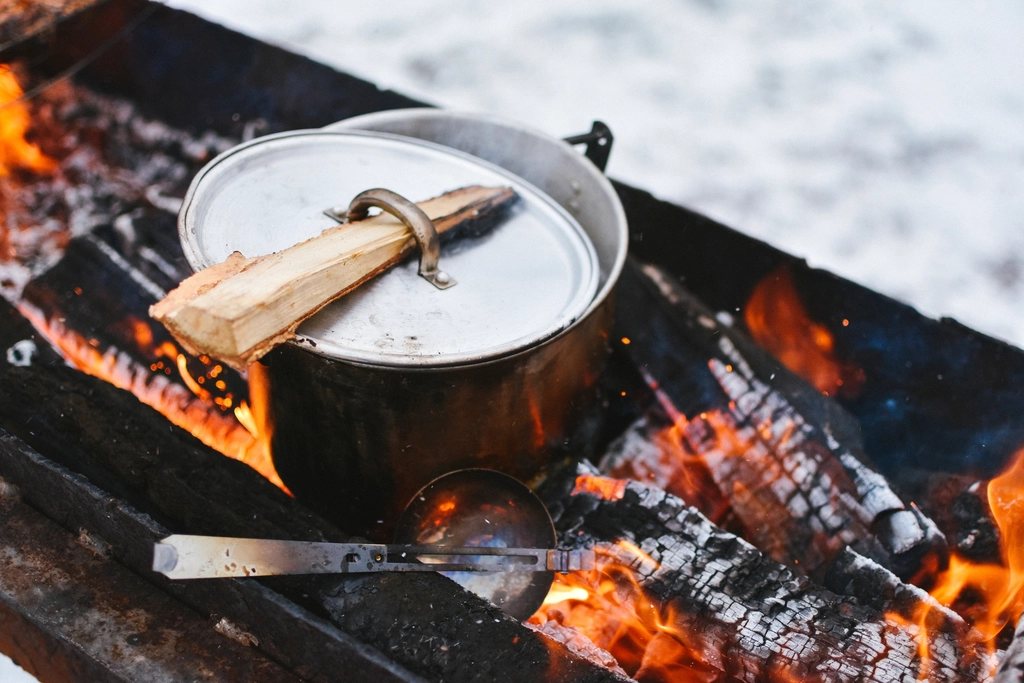
A single 750 ml pot with a lid covers one rider and, with patience, two. It boils half a litre for a meal or a coffee, it nests the burner and a 100 g cartridge inside, and it weighs around 100 g in titanium or 150 g in aluminium, which conducts heat better and burns food less. We carry a long-handled spoon, a small lighter with a backup in the repair kit, and a folding windscreen made from a strip of foil. That is the whole kitchen. The stove kit lives in the frame bag with the food, where its weight sits low and central, and the fuel cartridge is checked each morning by weight: a 100 g cartridge holds 100 g of gas and weighs about 200 g full, so a kitchen scale in a hostel or a simple guess by hand tells us how many boils remain. For one rider boiling about 1.5 litres a day, a 100 g cartridge lasts five to seven days; a 230 g cartridge, better value and only 150 g heavier when full, lasts two weeks.
One-pot meals that survive the frame bag
The constraint that shapes everything is that food on a bike gets crushed, warmed and shaken for eight hours before it is eaten. That rules out anything fragile and favours dense dry staples that cook in the pot with water and little else. Our evening meals rotate through a short list that fits in one paragraph: couscous, which needs no simmering at all, just boiling water and a lid for five minutes; red lentils, which cook in 15 minutes and take stock powder, a tin of tomatoes and any vegetable that survived the day; polenta, which is done in five minutes and takes cheese; instant noodles with a tin of fish and a handful of dried mushrooms; and rice, the slowest at 12 to 15 minutes but the easiest to find anywhere in the world. Each is a base for whatever the last shop offered: an onion, a courgette, a sausage, a packet of hard cheese. Fat is the calorie that counts on a bike, so olive oil in a small bottle, butter in cool weather or peanut butter travel with us always. Breakfast is oats with milk powder and whatever dried fruit is left, or simply the previous evening’s bread. Lunch is not cooked. It is bread, cheese, tinned fish, fruit and something sweet, eaten in three or four small stops rather than one long one, which keeps blood sugar level and avoids the mid-afternoon collapse.
Finding the resupply rhythm
The rhythm is the part that takes a few trips to learn. In most of Western Europe a village with a shop or a bakery appears every 20 to 40 km, so we carry one evening meal, one breakfast and a day of snacks as a buffer and shop most afternoons. The buffer covers the closed shop, the Sunday, the long lunch break that shuts everything from noon until four in Spain, Italy and rural France, and the village that turned out to have a church but no bread. In Scandinavia, Iceland, the Balkans and the American West the gaps stretch to 100 or 200 km, and the buffer grows to two or three days. On the Great Divide the longest stretch without a shop is the Great Basin in Wyoming, about 200 km of sagebrush and wind, and riders leave the last town with three days of food and four litres of water. Two habits help. We check shop hours the evening before, not on arrival, and we shop for the next 24 hours only, plus the buffer, rather than filling every bag because the shop was good. Food is the heaviest thing on the bike after water, and an over-full frame bag on day one is a broken spoke waiting for day two.
Water, washing up and leaving no trace
Cooking uses water, roughly half a litre per hot meal and another quarter for a hot drink, so the evening pitch is chosen with a water source in mind or the water is carried in from the last stream. Washing up is done with a splash of water and a finger, never soap in a stream, and the grey water is scattered on the ground at least 50 m from any watercourse. In bear country the kitchen moves 100 m from the tent and the food is stored properly, which is a subject of its own. Everywhere else, the stove is used on bare earth or rock, never on dry grass, and the cartridge, empty or not, rides home with us. A hot meal at the end of a hard day is one of the great pleasures of travelling by bike, and it costs about 450 g of stove, pot and fuel to make it possible for a fortnight. We have never regretted carrying it.