
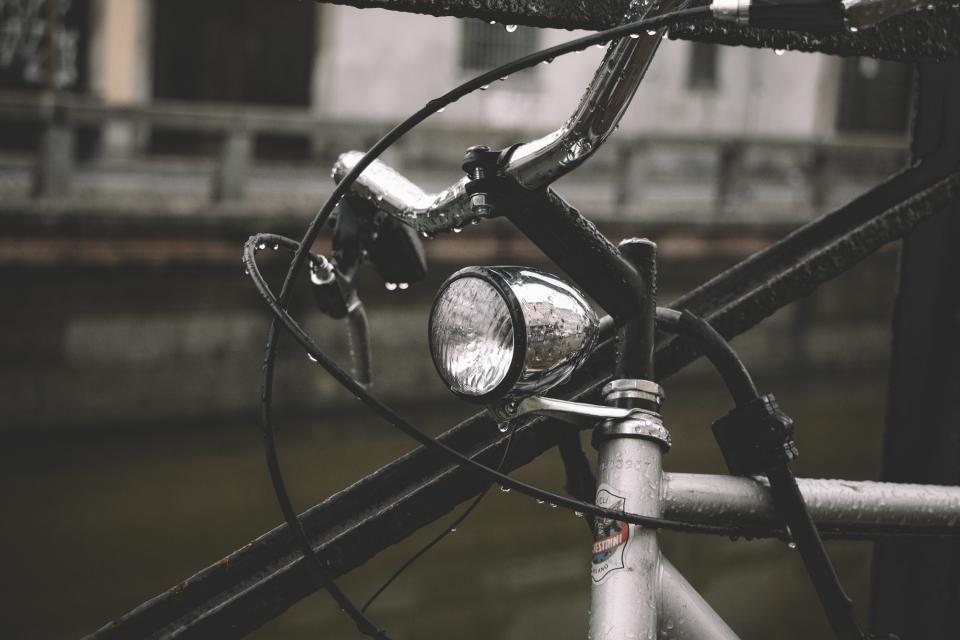
The appeal of a dynamo is obvious on paper: a hub that makes electricity for as long as the wheel turns, with no batteries to charge, no sockets to find and no rationing of the headlight on a long winter descent. We have run dynamo systems on tours from a week to three months, and the promise holds, with caveats that catalogues never mention. This is what a hub dynamo actually delivers, what it will and will not charge, and how we wire it so it keeps working after the tenth rainstorm.
What a hub dynamo actually produces
Nearly every hub dynamo sold today is rated at 6 volts and 3 watts, a standard that dates from an era of incandescent bulbs and has stuck. The 3 watts is the nominal output at around 15 km/h on a 700c wheel; it rises with speed but the regulation in the lamp or charger caps what reaches the load. The practical upshot is that a dynamo delivers useful power from about 12 km/h, its full rated power from about 15 to 20 km/h, and not much more above that. On a loaded bike averaging 15 km/h on gravel, expect close to the nominal figure on the flat and much less on climbs below 10 km/h, which on a mountain day can be a third of the riding.
The cost in effort is real but small. Drag with the lights on is around 3 to 6 watts at 20 km/h, which is roughly a two percent tax on a touring effort of 150 watts. With the lights off and nothing charging, it drops to under 1 watt. Riders who claim to feel it are usually feeling the bearings.
Hub weight is 400 to 600 g, against 100 to 150 g for a plain front hub. Bottle dynamos that rub on the tyre are lighter and cheaper but slip in the wet and wear tyres; we stopped using them years ago.
Lights: the thing dynamos do best
Lighting is where the dynamo has no equal on a long tour. A modern dynamo headlamp uses a light-emitting diode behind a shaped reflector that throws a flat beam with a sharp upper cut-off, so it lights the road rather than the treetops and does not dazzle oncoming drivers. Good ones produce 100 lux or more at 20 km/h, which is enough for a 50 km/h descent on tarmac and comfortable for 25 km/h on gravel. Most include a standlight, a small capacitor that keeps the lamp on for three or four minutes at a stop.
The rear light wires off the headlamp and runs on a fraction of a watt. Fitting both means there is never a night when the lights are flat, never a morning spent charging, and no reason to skip an early start in December. For riders who tour outside summer, that alone justifies the hub.
Mounting matters. The lamp wants to sit on the fork crown or on a bracket at the front axle, below any bar roll, and the wires want to run down the fork leg with tape or small clips. A lamp mounted on the bars is blocked by the roll and vibrates on gravel until the beam points at the sky.
Charging: what to expect and what not to
This is where expectations run ahead of physics. Three watts is three watts. A modern phone charging from a wall draws 10 to 20 watts; from a dynamo through a converter it draws about 2.5 watts at cruising speed, with losses. In practice we get 300 to 500 milliamp-hours into a phone per hour of riding at 15 to 20 km/h, and nearly nothing below 12 km/h. On a 7-hour riding day with mixed terrain that is roughly a full phone charge, or half a large power bank.
The converter, which turns the hub’s alternating current into a regulated 5 volts on a standard port, is the weak point of most systems. Cheap ones cut out at low speed and reset the phone’s charging every time, which damages nothing but drains more than it gives. Better units include a small buffer battery that smooths the supply and delivers a steady charge even through a slow climb, and that buffer is what makes the difference between a system that works on gravel and one that only works on flat tarmac.
Our rule is never to charge the phone directly from the hub. We charge a power bank of 5,000 to 10,000 milliamp-hours all day, then charge the phone, headlamp and any other devices from the bank in the tent. The bank tolerates the interruptions, the phone stays dry in a bag, and the system degrades gracefully: a slow day just means a less full bank.
Lights or charging, not both
A 3-watt hub cannot run a 3-watt lamp and a 2.5-watt charger at once. Most set-ups use a switch, or the lamp has a port that diverts power to charging when the lamp is off. In summer, that means charging all day and lights at dusk. In winter, when the lamp is on for hours, the charging budget shrinks to almost nothing, and a solar panel or a larger power bank has to fill the gap. This is the trade-off nobody mentions: the dynamo is best in exactly the season when charging is least needed, and weakest when lights are on all the time.
Wiring and waterproofing
- Use the two-wire connectors from the hub with a drop of dielectric grease and a short spiral of tape over the join; corrosion is the most common failure.
- Run wires along the inside of the fork leg and the underside of the down tube, taped every 15 cm so nothing can catch on a stick.
- Leave a loop of slack at the head tube so the wire survives full steering lock.
- Put the converter inside the top tube bag or frame bag, never exposed, with the port pointing down.
- Carry 1 m of spare wire and two spade connectors. A cut wire is a five-minute repair with them and a day without lights without them.
- Check that the front wheel can be removed and refitted without straining the connectors: a puncture on the front should not mean rewiring.
Is it worth it
A dynamo hub, a good headlamp, a rear light and a converter with buffer cost between 300 and 600 euros, plus a wheel build. That buys a lot of power banks. On a tour of a week in summer, with towns every day, we would not bother; a 20,000 milliamp-hour bank and an overnight in a cafe covers it. On anything longer, anything remote, or anything with real darkness, the dynamo has paid for itself in the freedom it gives: no sockets to find, no rationing, no head torch on the bars at 2 am on a 40 km descent. It is the one upgrade we would not tour without in autumn or spring, and we leave it on the bike even when the trip is short, because it is simply always there.