
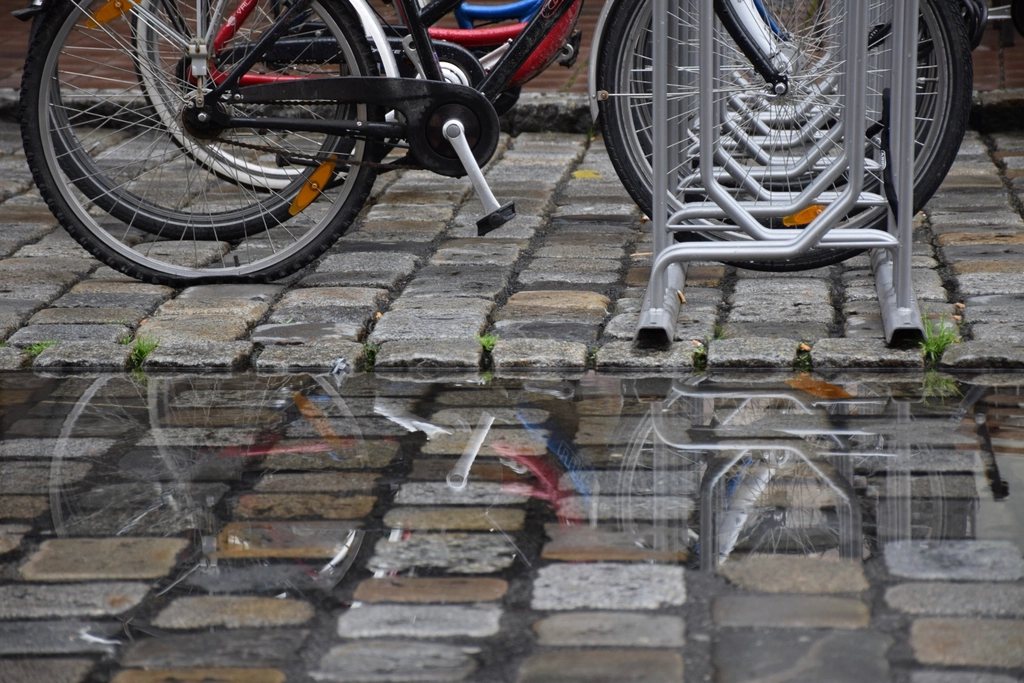
Rain on a bike trip is rarely dangerous, but it is relentless in a way that a wet day on foot is not: the wheels throw water upward as well as the sky throwing it down, and every bag on the bike is in the spray zone for eight hours. The one item that cannot be allowed to fail is the sleeping bag, because a wet bag in a wet week is a cold night that becomes a cold trip. We learned this on the west coast of Scotland, where the hills see rain on more than 250 days a year and a week of it in a row is not weather, it is the climate. What follows is the system we built afterwards.
Understand where the water comes from
A sleeping bag gets wet from four directions, and each needs a different answer. Rain and wheel spray attack it while riding, through the seams and roll-top of whatever bag it is packed in. Condensation attacks it at night, dripping from the inner wall of a single-skin tent or wicking in wherever the footbox touches the fly. The rider’s own body attacks it, because we sweat around a litre a night and in a cold tent that moisture stops in the insulation instead of passing through. And a wet tent attacks it in the morning, when a dripping fly gets packed next to it in the same seat pack. Down loses most of its warmth when its loft collapses with moisture and takes a day of sunshine to recover; synthetic fill loses less and dries faster but weighs more for the same warmth. The choice between them is discussed below, but the discipline is the same for both, and the discipline matters more than the fill.
Packing: the bag goes in last and comes out first
The riding-hours defence is two layers of waterproofing, not one. The bag lives in its own roll-top dry bag, rolled at least three turns and clipped, and that goes inside the seat pack or handlebar harness, which is itself water resistant but never fully waterproof after a season of abrasion. The mat goes at the front of the seat pack, against the seatpost, where the spray from the rear wheel hits first. A mudguard on the rear wheel cuts the spray by more than half and is the single most effective piece of rain kit on a bike, which is why we fit one for any trip in an Atlantic climate. The tent, when wet, travels somewhere else entirely: strapped on top of the bars, in a side pocket, in its own bag on the rack. It never shares a compartment with the sleeping bag, and neither do the wet clothes.
The evening: dry hands, dry tent floor, dry bag
The order of the camp routine on a wet evening is what saves the bag. The tent goes up first, fly first if the design allows, and the inner is wiped with a small cloth before anything goes in. Wet outer clothes come off in the porch and stay there. Only then does the seat pack open, and the sleeping bag comes out of its dry bag directly onto the mat inside the inner. The bag is not unrolled until we are ready to get in, because a fluffed bag in a damp tent starts collecting moisture immediately. We change into dry sleeping clothes kept in the same dry bag as the sleeping bag, and everything damp is kept out of the bag: no drying socks in the footbox, no wet hair on the hood. If the rain is warm we sleep with the bag partly open to let body moisture out; if it is cold we close it and accept a slightly damp morning, which is better than a cold night.
Condensation, the quiet enemy
On a wet week the rain rarely gets in; the condensation always does. A single-skin or hybrid tent in still, humid air will drip from the inside by two in the morning, and the footbox of the bag is where it lands. We pitch for airflow even when it is raining: doors partly open on the sheltered side, the fly pegged out taut so that it does not touch the inner, and the tent on a slight rise rather than the flat spot beside the stream where the mist settles. A mat that keeps the bag off the tent floor by 5 cm matters, since floors get wet from below through the groundsheet where we kneel. In the morning the bag is shaken out and, if the rain has stopped for even 20 minutes, draped over the bike or a fence; 20 minutes of wind does more for down than an hour in a stuff sack does against it.
Down or synthetic for a wet climate
We ride with down most of the year because it weighs half as much for the same warmth and packs smaller, and on a bike that space is precious. For a planned wet week we make a choice based on how much shelter the route offers. Where there is a hostel, a bothy, a hut or a laundrette every third night, down works, because it gets a chance to recover; a tumble drier on low for 40 minutes restores a damp down bag almost completely, and a warm hostel room overnight does most of the same job. Where there is no roof for a week, we take a synthetic bag and carry the extra 300 g. A few points that hold in either case:
- Hydrophobic-treated down resists moisture for a night or two but is not a substitute for keeping the bag dry.
- A bivy bag over the sleeping bag adds condensation from within and is worth it only under a tarp, not inside a tent.
- A vapour barrier liner, a simple waterproof sack worn inside the bag, stops body moisture reaching the insulation on very cold wet nights and is the cheapest fix for a multi-day cold soak.
- A bag that is merely damp at the surface is fine; a bag whose loft has visibly dropped needs a dry day, a hostel or a drier before the next cold night.
Plan the week around a dry night
The last defence is the route. When the forecast promises a week of rain, we plan a roof on the third or fourth night: a hostel, a mountain hut, a campsite with a drying room. The cost of one night indoors is usually less than the cost of a synthetic bag, and it resets everything: bag, clothes, tent, morale. We also shorten the days, because a wet camp set up in fading light is a wet bag by morning, and we choose pitches with trees, walls or hedges that break the wind and the worst of the spray. None of this is complicated. It is the same 10 small habits repeated every evening until they are automatic, and the reward is a warm, dry bag on the seventh night of rain, which is worth more than any single piece of gear we own.