
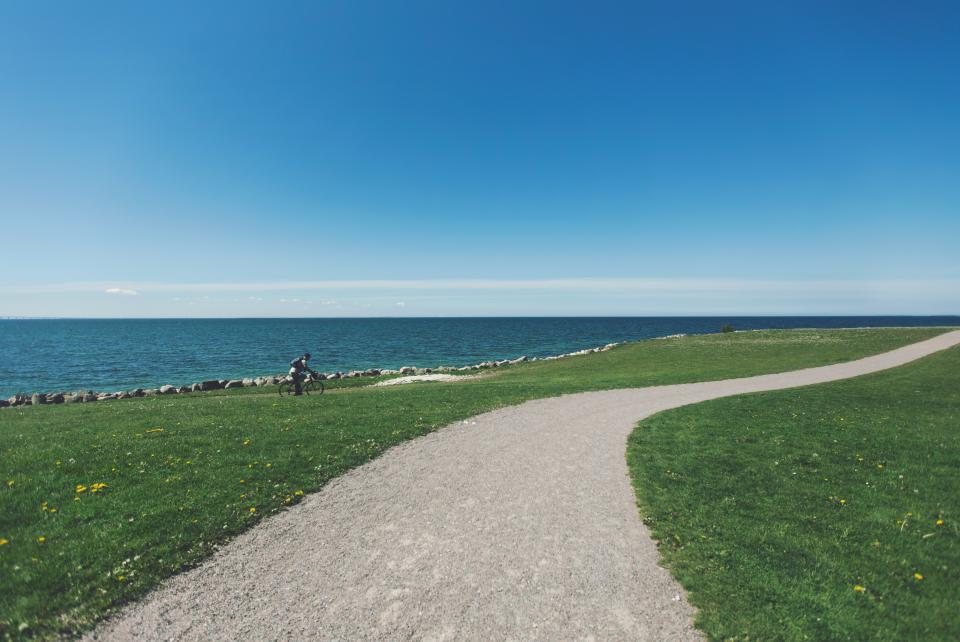
Nobody needs to start with a mountain range. The best first tour with a loaded bike is one where the gradient is gentle, the navigation is obvious, the surface is predictable and there is a town with food every couple of hours. Old railway lines and canal towpaths give you exactly that, and the world has thousands of kilometres of them. This is our case for spending your first week of bikepacking on a line that was engineered a century ago for something much heavier than a bike.
Why the engineering works in your favour
Railway engineers hated gradients. A steam locomotive pulling freight could manage only a few percent, so a rail line that crosses a mountain range does it with cuttings, tunnels, viaducts and long, patient climbs that rarely exceed two or three percent. Canals are stricter still: water does not flow uphill, so a towpath is flat between locks and rises only in short steps beside them. For a bike carrying 15 kg of camping gear, this changes everything. You can ride all day in the same gear, you never have to push, and a tired beginner at the end of the afternoon is still safe on the descents because there are no real descents.
The second gift is navigation. A rail trail goes where the railway went, and the railway went to towns. Every 15 to 30 km there is an old station, and the town that grew around it usually still has a bakery, a shop and water. There are no junctions to get wrong, no map to read in the rain, and no way to accidentally add 300 m of climbing.
Surfaces: what to expect under the tyres
Rail trails and towpaths are not all the same. The most common surface on converted railways is crushed stone or fine gravel, rolled and compacted, which rides well on 35 mm tyres and beautifully on 40 to 50 mm. Some are fully paved. Some, especially in wetter climates, degrade to mud in spring or after heavy rain and become slow, sticky work. Towpaths vary even more: paved in cities, hard-packed earth and gravel in the countryside, and sometimes grassy or rutted where the canal is little used. A tyre of 40 mm or wider with a light tread is the safest all-round choice, and mudguards make the difference between an enjoyable wet day and a miserable one.
Tunnels deserve a word. Long railway tunnels on rail trails are often unlit, sometimes hundreds of metres long, and wet inside. A real front light, not a commuter blinker, is part of the kit.
Routes that make a good first week
These are lines we would happily send a friend on for a first loaded tour, with distances that fit five to eight days at a relaxed 50 to 70 km a day.
- Canal du Midi, France: about 240 km from Toulouse to the Mediterranean lagoon near Sete, under plane trees, past locks and wine villages; the towpath surface is rough in places, so wide tyres help.
- Great Allegheny Passage and the Chesapeake and Ohio Canal towpath, United States: about 240 km of rail trail from Pittsburgh to Cumberland, then about 300 km of canal towpath to Washington, with campsites spaced along the whole line.
- Danube cycle path, Austria: around 320 km from Passau to Vienna, mostly paved, with a ferry or bridge to change banks and a town every few kilometres.
- Vennbahn, Germany, Belgium and Luxembourg: about 125 km on an old rail line from Aachen to Troisvierges, climbing very gradually through the Eifel and the High Fens on asphalt.
- Otago Central Rail Trail, New Zealand: about 150 km of gravel through dry inland Otago, with old station shelters and small-town pubs, and a sensible season from October to April.
- Katy Trail, United States: about 380 km of crushed limestone along the Missouri River, the longest continuous rail trail in the country, with towns and camping along the way.
- Parenzana, Italy, Slovenia and Croatia: about 130 km of narrow-gauge rail bed from Trieste to Porec through olive groves, tunnels and hill villages, with sea views on the Istrian side.
Packing for flat terrain
A flat route forgives weight, which is a trap. Because you can carry more without suffering, it is tempting to bring the camp chair and the second stove. Our advice is to pack for the tour you want to grow into: a bike setup you could take on a hillier route next year. That means keeping the total load under about 12 to 15 kg including water, using either a pair of rear panniers or a frame bag plus seat pack, and leaving the bulky camping luxuries at home. Practise the packing at home, ride a loaded 30 km loop before the trip, and adjust anything that rattles or rubs.
The one thing a flat tour does not forgive is a sore backside. Long hours in the same gear on the same surface mean the same pressure points for six hours, and beginners underestimate this. A saddle that fits, padded shorts and a habit of standing on the pedals every ten minutes are worth more than any other comfort upgrade.
Sleeping along the line
Rail trails and towpaths are often lined with campsites, and in some countries with free or cheap trail shelters spaced a day apart. Where that is not the case, the towns are close enough to book a room every night, which is a perfectly honest way to do a first tour. If you plan to wild camp, remember that a disused railway or canal corridor is usually a narrow strip of public land bordered by private fields; pitch late, leave early, and keep your tent out of sight of houses. Water is rarely a problem on a canal, but canal water is not drinking water, so fill up in towns and carry two litres.
What the first tour teaches
By the end of a week on a rail trail you will know how your bike handles with weight, how far you actually want to ride in a day, whether your sleeping mat is warm enough, and what you packed and never touched. Those lessons are the whole point. The mountains are not going anywhere, and the version of you that arrives at them after a flat week with a loaded bike will enjoy them a great deal more than the one who started there.