
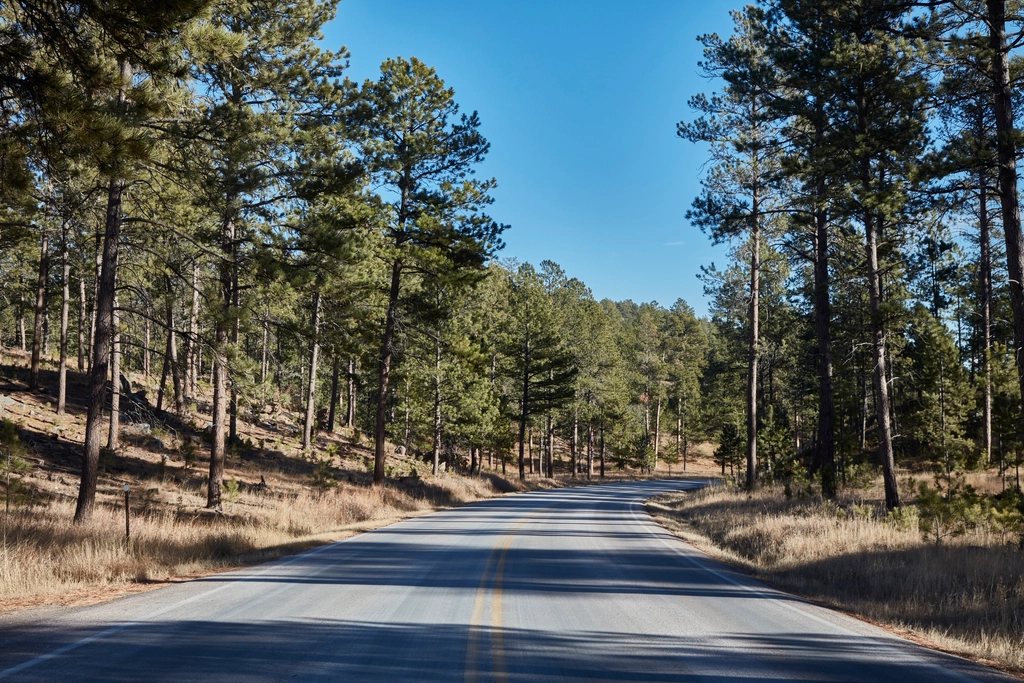
A bike changes the bear problem in two ways, and neither is in our favour. We move fast and almost silently, which means we can round a bend in a berry patch and be 20 m from an animal that would have heard a walker 200 m away. And every bag on the bike has held food at some point: the snack pouch on the bars, the frame bag that smelt of cheese for a week, the seat pack that once carried a leaking jar of peanut butter. A bear’s nose reads all of that. None of this makes bear country dangerous to ride through; the Great Divide crosses grizzly range for more than 1,000 km and has done so safely for thousands of riders. It does mean the camp routine has to be different, and it has to be the same every single night.
Which bears, and where
Two species matter for most riders. Black bears are found across most of forested North America, from the Appalachians to the Pacific coast and north into Canada and Alaska, and they are the bear that raids campsites, having learned that tents mean food. Brown bears, called grizzlies inland, live in the northern Rockies from Wyoming to the Yukon, in coastal Alaska and British Columbia, and in Europe in the Carpathians, the Dinaric Alps, Scandinavia and a few small populations in the Pyrenees, the Cantabrian mountains and the Italian Alps. Romania alone holds several thousand, the largest population in Europe outside Russia, and a night in the Fagaras foothills needs the same discipline as one in Montana. Japan has brown bears on Hokkaido and Asiatic black bears on Honshu. The behaviour differs: a black bear that approaches a camp is usually after food and will generally leave if confronted loudly; a brown bear is defending space or cubs, and the advice reverses to backing away slowly and never running. Knowing which species lives where the route goes decides how we react, so we check before we start rather than at the moment it matters.
Food storage: the three options
The point of storage is that nothing with a smell spends the night within reach of the tent or the bike. That includes food, rubbish, toothpaste, sunscreen, lip balm, the pot and the clothes we cooked in. There are three ways to keep it safe. A hard-sided bear canister is the only method accepted everywhere; several national parks and forests in the American West and in Alaska require one on the trail, and rangers check. A canister holds five to seven days of food for one rider, weighs around a kilogram and is a nuisance on a bike, riding best strapped flat on a rear rack or on top of a seat pack harness. A bear-resistant fabric sack, made of a cut-proof weave and tied to a tree trunk, weighs a fifth as much and is accepted in many areas but not all. And the hang, the old method, needs a branch at least 4 m up with the bag hauled 1 to 2 m out from the trunk and clear of the ground, which in lodgepole pine or above the treeline is often impossible. Established campsites in bear country usually provide a steel locker or a cable, and where they exist, we use them and camp there. Whatever the method, the food goes at least 100 m from the tent, downwind, and so do the bike bags that carried it.
The triangle: where to cook, sleep and store
The camp is laid out as a triangle with sides of about 100 m. One corner is the tent, on the upwind side, away from game trails, berry patches, streams with fish in them and any sign of digging or scat. One corner is the kitchen, where we cook, eat and wash up, and where the clothes we cooked in stay if we are being strict. The third corner is the food store, which in practice is also where the bike leans, since the bags are as scented as the food they held. We cook early, before dark, so that the smell has hours to dissipate, and we eat everything we cook rather than burying or scattering scraps. Water for washing is scattered widely away from the tent. Nothing edible ever enters the tent, not a wrapper, not a mint, and the sleeping clothes are ones that never went near the stove. It takes 15 minutes more than a normal camp. In four seasons of doing it we have never had a bear at the tent, and we do not believe that is luck.
Riding so as not to surprise anything
Most dangerous encounters with brown bears are surprises at close range, and a fast, quiet bike on a wooded trail is the ideal machine for producing one. We slow down at blind corners and where the trail runs through thick brush, and we make noise where the sightlines are short: talking, a bell on the bars, a shout of hello every 30 seconds through the worst of it. Dawn and dusk, when bears feed, are the times to be most careful and, if possible, on open ground. Bear spray rides on the bike where a hand can reach it without stopping, in a holster on the top tube or the stem, not buried in a bag. It cannot be flown with, so in North America it is bought on arrival and often given away at the end of the trip. Its range is about 8 m and it works on a charging animal, which is its only purpose. If a bear is seen at a distance, we stop, group up, and let it move on, and we never ride past a bear at speed, which can trigger a chase. Dogs are left at home in grizzly country.
A night-by-night routine that does not slip
The discipline fails not on the first night but on the sixth, when we are tired, it is raining and the tempting thing is to keep the snacks in the tent. So we write the routine into the day. The food bag is packed at the last shop so that everything scented is in one place, which makes the evening move a single job. The snack pouch on the bars is emptied at the last stop before camp and the wrappers go into the food bag. Camp is chosen with the triangle in mind, which means arriving with an hour of light rather than 10 minutes. Dinner is cooked, everything is washed and stored, and only then does the tent go up. In the morning the store is retrieved last, after the tent is down. Where a locker or a canister is required by the land manager, we carry one; where a hang is allowed and possible, we practise it before the trip rather than at dusk with a headtorch. Bear country is some of the finest riding on earth, and a good routine is the price of a quiet night in it.
Read next: Choosing a Mattress for Cyclists: Warmth, Weight and Pack Size