
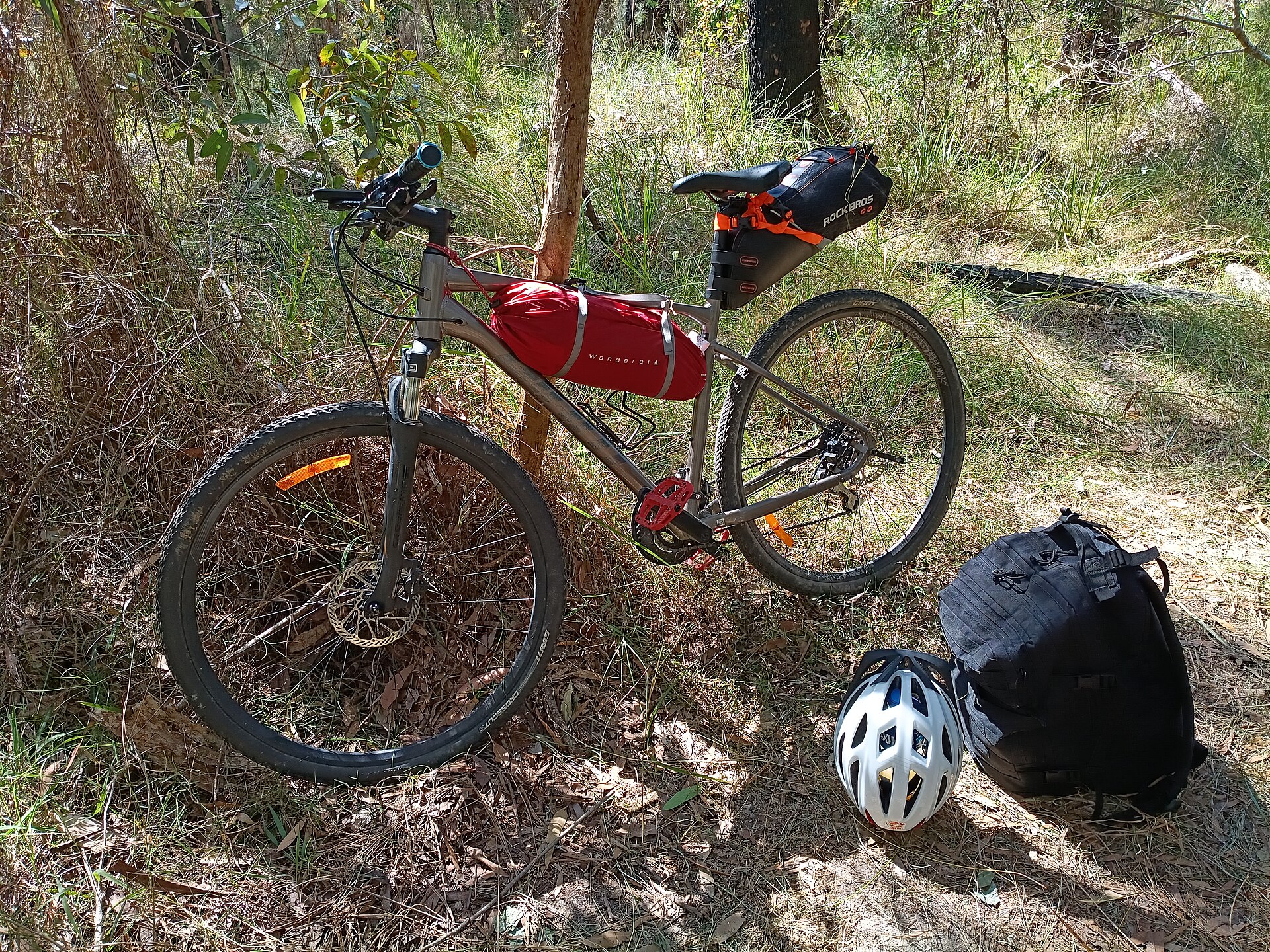
The right mattress for cyclists is the one that is warm enough for your season, small enough to fit your bag, and tough enough to survive weeks of rolling and unrolling. For a loaded bike, an inflatable air pad usually wins on pack size, while closed-cell foam wins on durability. This guide shows how to weigh those trade-offs for your own trip.
What does a cyclist actually need from a sleeping mat?
Most people think of a mat as a comfort item, but on a bike tour its first job is insulation. The ground pulls heat from your body far faster than cool air does, and a sleeping bag cannot help much underneath you because the fill is crushed flat. That is why a thin, comfortable mat can still leave you cold, and why warmth should come before softness in your list of priorities.
The second job is fitting into a bike’s limited luggage space. Anything strapped outside the bags adds drag, rattles on rough surfaces, and gets wet. A mat that packs to the size of a water bottle can live inside a bag or a handlebar roll, while a bulky foam pad has to ride on the outside of the bike.
The third job is surviving the trip. A mat that leaks halfway through a tour costs you sleep and money, so how it fails matters as much as how it feels on night one.
- Warmth: the first filter for any shortlist.
- Packed size: measured against the bag you will actually use.
- Durability and repairability: especially around the valve.
- Weight: the last tie-breaker, not the first.
How do you read warmth ratings for your season?
Manufacturers describe insulation with an R-value. A higher number means better resistance to heat loss, and the number is the easiest way to compare mats across brands and types, including foam against air.
Published figures give you useful anchors. One self-inflating three-season mat is listed at an R-value of 2.4, a folding closed-cell foam mat at 1.7, and a current ultralight air pad at 4.5, which its maker describes as suitable for all seasons. These are manufacturer claims, so treat them as a guide for ranking mats rather than a guarantee of how warm you will feel.
As a practical rule, think in bands. A low R-value is fine for warm summer nights at low altitude. If your route crosses mountains, includes early starts in spring, or runs into autumn, step up to a higher band, because nights get colder than forecasts suggest.
Remember that you can stack insulation. A folding foam pad placed under another mat adds warmth and also protects the main mat from punctures. That is a cheap way to extend a summer mat into the shoulder season without buying a second one.
Your own physiology matters too. If you tend to sleep cold, choose the higher band even in summer. If you run warm, you can safely drop a band and save weight.
Foam, self-inflating or air: which type suits your tour?
There are three broad categories, and each has a clear personality.
Closed-cell foam
Closed-cell foam is simple and close to indestructible. It cannot puncture, needs no inflation, and works as a seat or a ground sheet in camp. The costs are bulk and a firmer feel. It also has to travel outside your bags, which is awkward on a streamlined bikepacking setup.
Self-inflating
A self-inflating mat uses foam inside to help it fill with air. Reviewers who use them note that the design is trusted and tested, and one owner reported a five-year-old example still holding air as well as when new. The drawbacks are a larger packed size than an air pad and, in one reviewer’s experience, less comfort and warmth than competing inflatables. Some are also not full length, which leaves part of your sleeping bag on the tent floor where it can pick up moisture.
Ultralight air pads
Air pads pack the smallest for their warmth and are the usual choice when bag space is tight. The risk is the valve area. Reviewers describe cheaper pads wearing and leaking around a hard plastic nozzle after rolling and folding, in one case within days and in another after roughly twenty nights. Pricier designs place the valve on a curve of the mat rather than a square corner and tend to wear better.
Quality varies widely inside this category, so a cheap air pad is a gamble. If you go that way, budget for a repair kit and a spare plan.
How do weight and pack size compare across a long route?
The honest answer is that the weight difference between good options is small compared with the rest of your load. In one side-by-side test, the mats ranged from a lightweight 320 g to a reasonable 550 g, and the author found packed sizes were quite similar across the group. Warmth did not track thickness neatly either, so a thicker mat is not automatically a warmer one.
Across a long route, a few hundred grams will not change your pace noticeably, but it will change how well you sleep on every one of the nights. Spend weight on warmth and comfort where it counts, and save it elsewhere.
Pack size is where choices bite harder. Before buying, measure the space in your bag or roll, then compare it with the packed dimensions listed for each mat. A pad described as shrinking to roughly the size of a one-litre water bottle is the benchmark for tight setups. Allow for the stuff sack, and for the fact that a mat never packs as small on day ten as it did in the shop.
- Foam saves money and worry but costs external space.
- Self-inflating mats sit in the middle for size and durability.
- Air pads save the most space but need careful handling and a repair plan.
Side sleepers and back sleepers: how should you weight the criteria?
Where you sleep on the mat changes which specifications matter most. Neither group can ignore warmth, but they should rank the remaining criteria differently.
Side sleepers concentrate pressure on the hip and shoulder, so thickness and cushioning matter more. A thin or underinflated mat lets those points bottom out against the ground, which is both cold and uncomfortable. If you sleep on your side, favour a thicker air pad and accept a slightly larger pack size or weight. Being able to fine-tune firmness by letting a little air out is also useful.
Back sleepers spread their weight across a broad area, so they can often get by with a thinner, lighter mat. They should still check length and width, because a mat that is too short leaves your feet or legs on the ground. If you toss and turn, a wider mat helps regardless of position.
Restless sleepers should also think about noise. Some air pads crackle whenever you move, and older versions of one popular model were described as noisy enough to wake a tent partner. Newer fabrics are quieter, but not silent, so if you share a tent, consider this alongside warmth.
Finally, think about the pillow. A mat that sleeps well with a small inflatable pillow lets you pick a thinner pad and still wake up comfortable, which is an easy way to balance weight against comfort.
Frequently asked questions
Is a foam mat or an air pad better for bikepacking?
An air pad packs smaller and fits inside most bags, which suits a tight bikepacking setup. A closed-cell foam mat is tougher and cannot puncture, but it must be strapped outside the bags. Choose by how much luggage space you have and how much you worry about leaks.
What R-value should a cycling mattress have?
Pick a low R-value for warm summer nights and step up for spring, autumn or mountain camps. Published figures include 1.7 for a folding foam mat, 2.4 for a three-season self-inflating mat and 4.5 for an ultralight air pad. You can also stack a foam pad under another mat to add warmth.
How long does a cheap air mattress last on tour?
It varies a lot. One reviewer reported cheap cylinder-style mats lasting roughly twenty nights before leaking around the valve, while a more expensive pad survived weeks in Tibet. Carry a repair kit whichever you choose.
Should you buy a full-length mat?
Usually yes. A shorter mat leaves part of your sleeping bag on the tent floor, where it is more likely to get damp. If you do use a shorter mat, put your pack or spare clothes under your legs.
Related reading
- Cooking from the Saddle: Stoves, One-Pot Meals and the Resupply Rhythm
- A 900 g Sleep System That Actually Works on a Bike Trip
Sources
- The Best Sleeping Mat for Bike Packing (welovemountains.net, accessed 2026-11-02)
- Why A Thermarest Is The Best Sleeping Pad For Bike Touring (reallybigbikeride.com, accessed 2026-11-02)
Photo: Lightweight Cycle Touring Setup with Camping Gear and Supplies, by JaredMcKenzie, CC0 (Wikimedia Commons)