
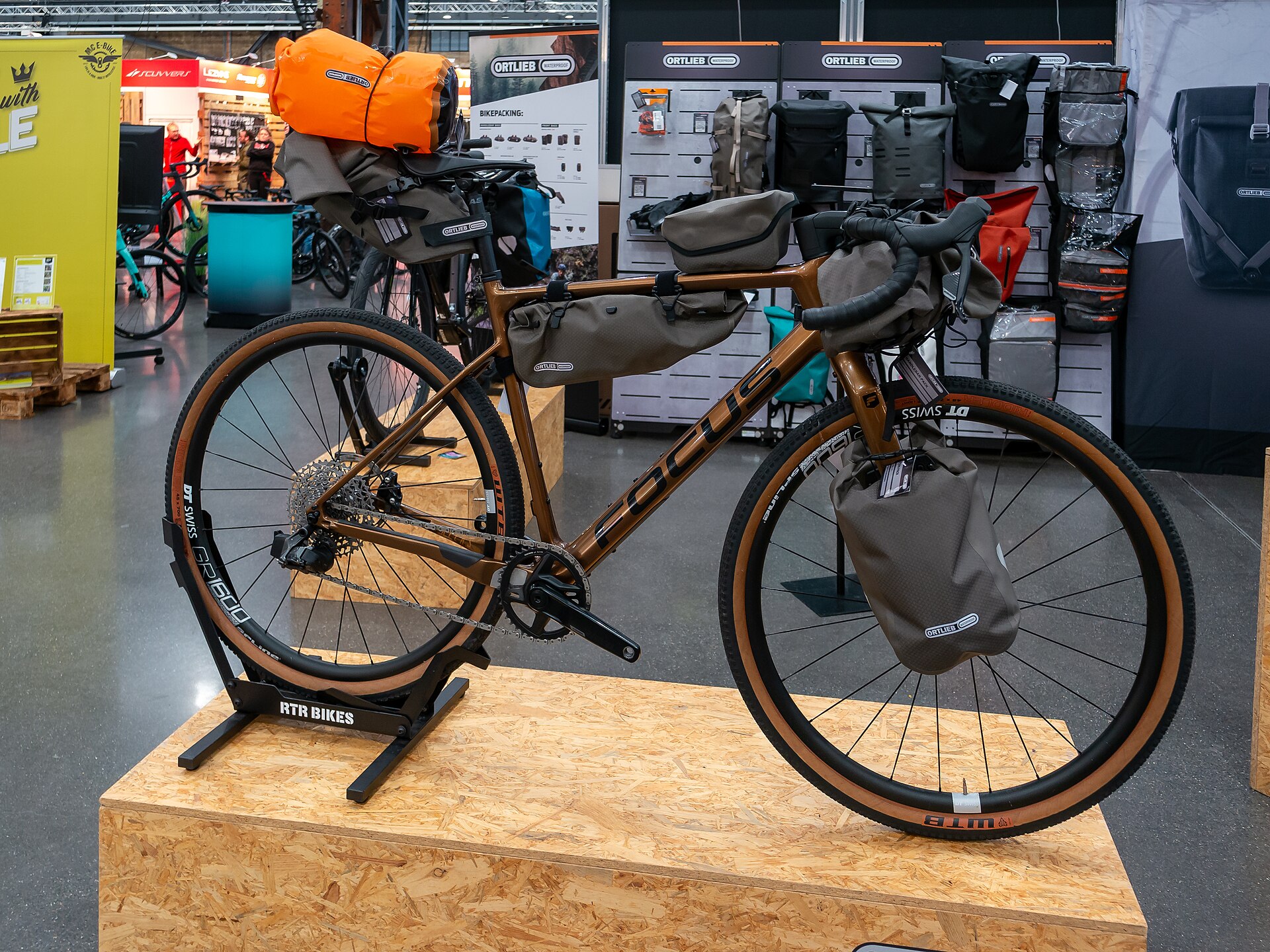
A gravel bike is a drop-bar bicycle built to cover mixed surfaces at speed: it takes road-bike efficiency and adds wider tyres, a more relaxed frame, disc brakes and extra mounting points. For most bikepacking on gravel roads, canal paths and easy singletrack it is a sensible default. For heavy loads or truly rough ground, a touring bike or a mountain bike can fit better.
What makes a bike a gravel bike?
At a glance a gravel bike looks like a road bike: drop bars, a lean frame, a rigid fork on most models. The differences are in the details, and each one exists to keep you comfortable and in control when the surface gets loose or broken. Think of the category as a blend: the efficiency of a road bike, some of the mounting options of a touring bike and a measure of off-road ability borrowed from mountain biking.
The features that define the category are these:
- Relaxed geometry. The frame is slower to turn than a road bike but steadier, especially on low-traction descents.
- Generous tyre clearance. The frame accepts wider tyres than a road or cyclocross bike, so you can run a more cushioning tyre with real grip.
- Disc brakes. They keep working in mud, dust and rain, and many bikes use hydraulic versions.
- Extra mounts. Expect bosses for bottle cages, racks and fenders, and on some models carry points shaped for bikepacking bags.
- Lower gearing. The gear range typically runs easier than on a road bike, which matters once there is weight on board.
The idea is versatility rather than specialisation. That is why the category suits riders who want one bike for the commute, the weekend dirt road and the occasional multi-day trip.
How do the design choices affect a loaded ride?
Four decisions shape how a gravel bike behaves once it carries a tent, a sleeping bag and a few days of food. Read each one against the kind of route you plan.
Geometry
A longer wheelbase and a slacker head angle make the bike feel planted when the front end is loaded and the surface shifts under you. Bikes aimed at long-distance riding push this further: longer, lower and slacker, with a stable feel under a full load. Race-oriented gravel bikes go the other way, with steeper angles and shorter wheelbases for quick handling. If your priority is carrying kit for days, lean toward the stable end.
Tyre width
Tyre width is the single biggest lever on comfort and grip. Most gravel frames take tyres around 40 mm, and some go to 45 or 50 mm. Wider means more cushion and traction on rough or loose ground, narrower means less weight and faster rolling on hard-packed roads. Because the right pressure matters as much as the width, the separate piece on tyre width and pressure goes deeper on how to choose.
Gearing
Gravel drivetrains come as 1x (a single chainring) or 2x. Cheap models sometimes use three front gears. Whichever you pick, check the lowest gear before you commit, since a loaded bike on a long climb is where a gear that seemed fine in the shop stops being fine. The numbers are explained in the guide to gearing for loaded climbs.
Mounts and frame materials
Look for the fittings you need before anything else: three-pack bosses on the fork, rack mounts, and enough frame room for a bag. Frame material is a trade-off. Carbon fibre is light and absorbs vibration, aluminium is durable and good value, and titanium and steel are also used. For a first bikepacking bike, durability and fittings usually matter more than a few hundred grams.
Where does a gravel bike do well, and where does it struggle?
A gravel bike is at its best on long gravel and dirt roads, fire roads, canal and rail-trail paths, and easy singletrack. It also handles the paved link sections that join these together without punishing you, which is why it suits routes that mix surfaces in a single day. If you must ride a stretch of smooth road to reach the good part, you lose little time doing it.
- Rough, technical trail. A rigid drop-bar bike gives you less control and comfort than a mountain bike once the ground turns rocky or steep. Most gravel bikes rely on tyre cushioning and frame flex, and the few that offer suspension give only around 20 to 30 mm of travel.
- Very heavy loads. A gravel bike rides well with a light to moderate load. A touring bike is built to carry far more and to ride best under that load.
- Hike-a-bike sections. A drop-bar bike is awkward to push over rough ground, and tall gearing makes it harder to turn the pedals on steep ramps.
Before you load up, it helps to know what your route actually asks of the bike, and understanding elevation gain before loading up is a good place to start: total climbing, more than distance, tells you how much gear range and how much patience you need.
Gravel bike, touring bike or hardtail: which one for your trip?
The three bikes overlap, so choose by the route you ride most often rather than by the label.
- Choose a gravel bike if your trips are mostly gravel roads, canal and rail trails and moderate singletrack, you pack fairly light, and you want a bike that stays quick and comfortable on pavement too.
- Choose a touring bike if you carry heavy loads on panniers over long distances and care more about strength and carrying capacity than speed. Touring bikes are built tougher and offer more space for racks and panniers.
- Choose a hardtail mountain bike if your route includes sustained rough trail, rocky descents or sections where control matters more than efficiency. You accept slower speed on smooth ground in return.
Your luggage choice feeds back into the decision. A bikepacking-bag setup suits the lighter, narrower build of most gravel bikes, while panniers lean toward a touring frame. If you are unsure, the comparison of bikepacking bags and panniers sets out what each costs you in weight, handling and money.
Gravel bikes also come in two broad flavours. Adventure and bikepacking models put comfort, stability and carrying capacity first. Racing models put speed and responsive handling first. For multi-day riding, the first type is nearly always the one you want.
What should you check before buying one for bikepacking?
Work through a short checklist rather than comparing spec sheets line by line.
- Tyre clearance. Make sure the frame fits a tyre wide enough for your roughest route, with room to spare for mud.
- Mounting points. Count the bosses for bottle cages, racks and bags, and confirm they suit the luggage system you plan to use.
- Lowest gear. Compare it against the steepest climbs on your intended routes, with a full load in mind.
- Brakes. Disc brakes are standard, so the question is whether you prefer hydraulic, which is common, or a mechanical system that is simpler to repair far from a shop.
- Wheels and tyre setup. Tubeless is the norm on gravel bikes because it resists punctures and pinch flats better than tubes, and a tubeless setup is easier to live with if you know how to plug a tyre on the trail.
- Fit and contact points. A relaxed riding position helps on long days, and bar width and saddle can be adjusted without changing the frame.
Finally, remember that any bike able to cover your terrain can do the job. The category exists to make that job easier, not to gatekeep it. If you already own a capable bike with the right clearance and mounts, test a short overnight trip before you spend anything.
Frequently asked questions
Is a gravel bike the same as a road bike with wider tyres?
No. A gravel bike has a longer wheelbase, a slacker head angle and a more upright position than a road bike. It also has more tyre clearance, disc brakes and extra mounting points, so the whole frame is designed around rough surfaces.
What is the difference between a gravel bike and a cyclocross bike?
A cyclocross bike is built for short, agile racing and is designed around 700c wheels with a tyre limit of around 33 mm. A gravel bike is more comfortable and stable over long distances and takes wider tyres, often around 40 mm and sometimes up to 50 mm. Gravel frames also offer the mounts that cyclocross frames usually lack.
Can you go bikepacking on a gravel bike?
Yes, and for most gravel roads, canal paths and moderate singletrack it is the usual choice. Look for a frame with plenty of mounting points and low gearing. For very heavy loads or rough trail, a touring bike or a hardtail may serve you better.
Should you choose a 1x or 2x drivetrain on a gravel bike?
Both are widely available. A 1x drivetrain is simpler and has fewer parts that can fail, while a 2x gives a wider spread of gears. Check the lowest gear against the climbs on your route rather than choosing by label.
Related reading
- Dynamo Lights and Charging on a Long Tour: What a Hub Really Delivers and How We Wire It
- Tyre Width and Pressure for Gravel and Loaded Touring: How We Choose, and Why Lower Is Usually Right
Sources
- What is gravel bike and is it right for you? (canyon.com, accessed 2026-11-09)
- What Is A Gravel Bike? (evocycles.co.nz, accessed 2026-11-09)
- Gravel bicycle — Wikipédia (en.wikipedia.org, accessed 2026-11-09)
Photo: Ortlieb, Cyclingworld Europe 2024, Meerbusch (P1170960), by Matti Blume, CC BY-SA 4.0 (Wikimedia Commons)